CSS Custom
Languages
 Bahasa Indonesia
 English
FH UNY Hosts Visiting Professor from UKM to Discuss the Legality of US–Israeli Military Action against Iran
Primary tabs
.
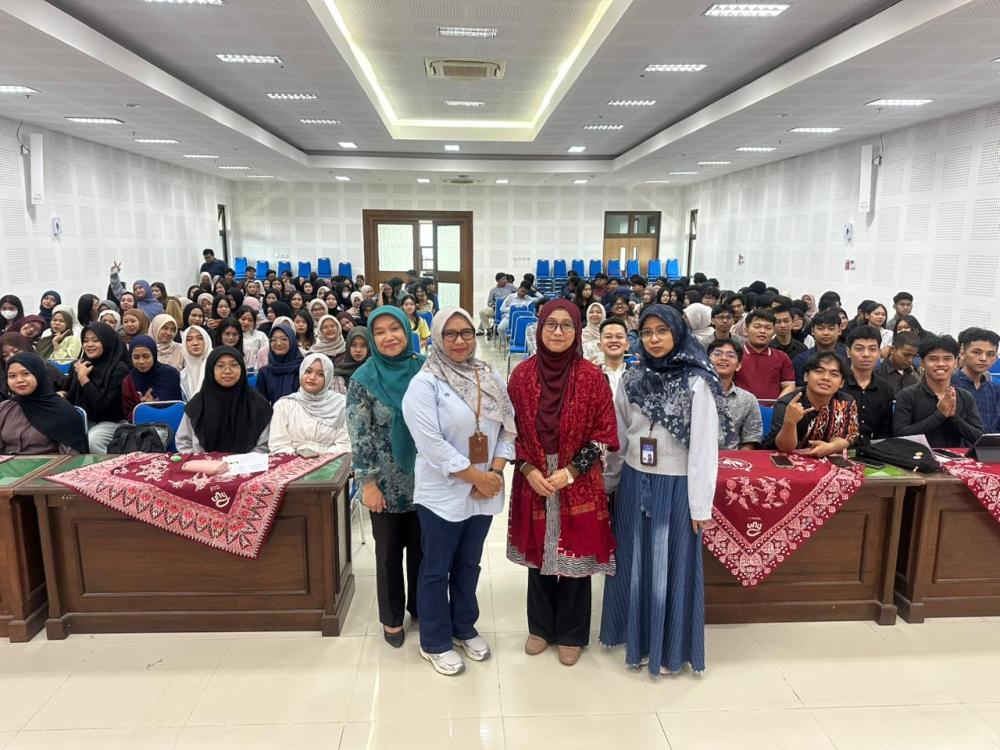
YOGYAKARTA – The Faculty of Law, Universitas Negeri Yogyakarta (FH UNY), organized an international public lecture as part of the Visiting Top Professor Program on Tuesday (May 5, 2026) at the IsDB Laboratory, FISIP. The lecture featured Assoc. Prof. Dr. Rohaida Nordin from Universiti Kebangsaan Malaysia (UKM).
The lecture, titled “The Legality of the US and Israeli Military Action against Iran and the Alleged War Crimes,” was attended by undergraduate students from the Law Study Program (Class of 2024 and 2025).
In her presentation, Dr. Rohaida outlined the development of the conflict and explained that its legal analysis can be understood through two main branches of international law, namely jus ad bellum (the legality of the use of force) and jus in bello (the law governing the conduct of war).
She explained that the initial strikes carried out by the United States and Israel against Iran are widely viewed by legal experts as inconsistent with the prohibition on the use of force under the Charter of the United Nations, particularly Article 2(4). She noted that, under international law, the use of force is only permitted in limited circumstances, such as in self-defense following an armed attack or when authorized by the United Nations Security Council.
Dr. Rohaida further stated that the military actions are often framed as preemptive self-defense, referring to the use of force to prevent a perceived future threat. However, she emphasized that this justification remains debated in international law and must meet strict requirements, including the existence of an immediate and overwhelming threat. If such criteria are not met, the use of force may be considered inconsistent with established legal principles.
She also discussed the arguments put forward to justify the use of force, including claims of collective self-defense and anticipatory self-defense, and presented counterarguments raised by international law experts, particularly regarding the absence of clear evidence of an armed attack and the strict conditions required under international law.
In addition, Dr. Rohaida addressed issues related to jus in bello or international humanitarian law. She highlighted concerns over potential violations, including attacks on civilians and civilian objects, the principle of proportionality, and statements that may be interpreted as denial of quarter, which is prohibited under the laws of war. She stressed the importance of distinguishing between military objectives and civilian targets in any military operation.
She also briefly noted that Iran’s responses to the attacks raise legal concerns, particularly in relation to cross-border actions and their implications under international law.
The session was interactive, with active participation from students. During the discussion, several questions were raised on key issues in international law, including the legality of preemptive strikes, the limits of self-defense, and the role of legal frameworks in armed conflict. One notable question addressed why international law regulates the conduct of war, rather than focusing solely on preventing war, which led to a brief reflection on the role of law in minimizing humanitarian impacts when conflict occurs.
The lecture also relates to the global agenda of the Sustainable Development Goals (SDGs), particularly Goal 16 on peace, justice, and strong institutions, as well as Goal 4 on quality education.
Discussion on Future Research Collaboration
Following the public lecture, Assoc. Prof. Dr. Rohaida Nordin was received by the leadership of the Faculty of Law, Universitas Negeri Yogyakarta (FH UNY) at the Dean’s Office. The meeting discussed the initiation of a joint research program as an initial step toward establishing research collaboration between FH UNY and Universiti Kebangsaan Malaysia (UKM).
The proposed collaboration is expected to include joint research, international scientific publications, as well as student and faculty mobility programs. This initiative aligns with the Sustainable Development Goals (SDG 17), which emphasizes global partnerships in advancing knowledge across borders.
The faculty leadership noted that this collaboration forms part of a broader internationalization strategy, as well as an effort to strengthen academic contributions in addressing global legal issues.
Through this initiative, FH UNY aims not only to enhance students’ academic capacity in understanding the dynamics of international law, but also to open opportunities for strategic collaboration at both regional and global levels.